Motivations for requesting counselling before and during the COVID-19 pandemic of Italian university students

Titolo Rivista PSICOLOGIA DELLA SALUTE
Autori/Curatori Chiara Petrocchi, Gaetano Maria Sciabica, Roberto Baiocco, Anna Maria Speranza, Silvia Andreassi, Mara Morelli, Silvia Cerolini, Alexandro Fortunato, Fiorenzo Laghi
Anno di pubblicazione 2026 Fascicolo 2026/1
Lingua Inglese Numero pagine 23 P. 100-122 Dimensione file 193 KB
DOI 10.3280/PDS2026-001007
Il DOI è il codice a barre della proprietà intellettuale: per saperne di più clicca qui

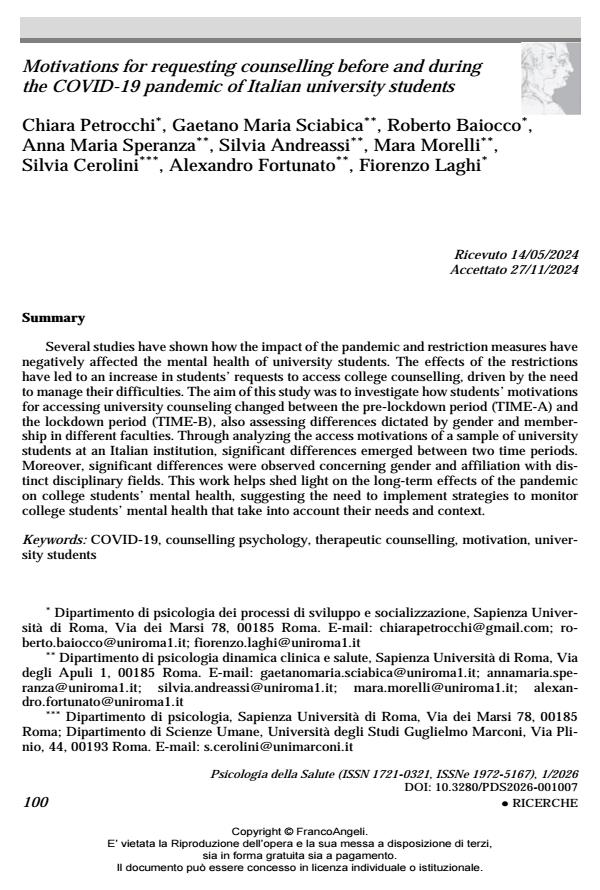
Qui sotto puoi vedere in anteprima la prima pagina di questo articolo.

Se questo articolo ti interessa, lo puoi acquistare (e scaricare in formato pdf) seguendo le facili indicazioni per acquistare il download credit. Acquista Download Credits per scaricare questo Articolo in formato PDF
Anteprima articolo

FrancoAngeli è membro della Publishers International Linking Association, Inc (PILA), associazione indipendente e non profit per facilitare (attraverso i servizi tecnologici implementati da CrossRef.org) l’accesso degli studiosi ai contenuti digitali nelle pubblicazioni professionali e scientifiche.

Several studies have shown how the impact of the pandemic and restriction measures have negatively affected the mental health of university students. The effects of the restrictions have led to an increase in students’ requests to access college counselling, driven by the need to manage their difficulties. The aim of this study was to investigate how students’ motivations for accessing university counseling changed between the pre-lockdown period (TIME-A) and the lockdown period (TIME-B), also assessing differences dictated by gender and membership in different faculties. Through analyzing the access motivations of a sample of university students at an Italian institution, significant differences emerged between two time periods. Moreover, significant differences were observed concerning gender and affiliation with distinct disciplinary fields. This work helps shed light on the long-term effects of the pandemic on college students’ mental health, suggesting the need to implement strategies to monitor college students’ mental health that take into account their needs and context.

Diversi studi hanno dimostrato come l’impatto della pandemia e delle misure restrittive abbia influenzato negativamente la salute mentale degli studenti universitari. Gli effetti delle restrizioni hanno portato a un aumento delle richieste degli studenti di accesso al servizio di counseling universitario, motivato dalla necessità di gestire le proprie difficoltà. L’obiettivo di questo studio è quello di investigare come le motivazioni di accesso ai servizi di counseling universitari degli studenti siano cambiate tra il periodo pre-lockdown (TIME-A) e il periodo del lockdown e post (TIME-B), valutando anche le possibili differenze determinate dal genere e dalla facoltà frequentata. Analizzando le motivazioni di accesso in un campione di studenti universitari presso un’istituzione italiana, sono emerse differenze significative tra i due periodi temporali. Inoltre, sono state osservate differenze significative riguardanti il genere e l’appartenenza a campi disciplinari distinti. Questo lavoro contribuisce a far luce sugli effetti a lungo termine della pandemia sulla salute mentale degli studenti universitari, suggerendo la necessità di implementare strategie per monitorare la salute mentale degli studenti universitari che tengano conto delle loro esigenze e del contesto.

Parole chiave:COVID-19, counselling psicologico, counselling terapeutico, motivazione, studenti universitari

  1. Bahrami, F. & Yousefi, N. (2011). Females are more anxious than males: a metacognitive perspective. Iranian Journal of Psychiatry and Behavioral Sciences, 5(2): 83-90.
  2. Babore, A., Morelli, M. & Trumello, C. (2021). Italian adolescents’ adjustment before and during the coronavirus disease 2019: A comparison between mothers’ and adolescents’ perception. British Journal of Clinical Psychology, 61(2): 281-286.
  3. Barnett, P., Arundell, L. L., Saunders, R., Matthews, H. & Pilling, S. (2021). The Efficacy of Psychological Interventions for the Prevention and Treatment of Mental Health Disorders in University Students: A Systematic Review and Meta-Analysis. Journal of Affective Disorders, 280: 381406.
  4. Barredo, R., Kanu, M., Gishe, J., Raynes, E., Cosby, B. & Tolleson, T. (2023). Stress and Stressors: The Impact of the COVID-19 Pandemic on Students, Faculty and Staff at a Historically Black College/University. Journal of Community Health, 48(2): 269-285.
  5. Beck, A. T. & Steer, R. A. (1993). Beck Anxiety Inventory manual. Harcourt Brace & Company: The Psychological Corporation Harcourt Brace.
  6. Beck, A. T., Steer, R. A. & Brown, G. K. (1996). Manual for the Beck Depression Inventory-II. Psychological Corporation.
  7. Bianchi, D., Baiocco, R., Pompili, S., Lonigro, A., Di Norcia, A., Cannoni, E., Longobardi, E., Zammuto, M., Di Tata, D. & Laghi, F. (2022). Binge Eating and Binge Drinking in Emerging Adults During COVID-19 Lockdown in Italy: An Examination of Protective and Risk Factors. Emerging Adulthood, 10(1): 291–303. DOI: 10.1177/2167696821105850
  8. Biasi, V. & Bonaiuto, P. (2014). The”Need for Harmony”Defence Mechanisms as Co-Factor in Stress Sensitivity Producing Sadness and Depression. Open Journal of Depression, 3: 173-183,
  9. Biasi, V., Mallia, L., Menozzi, F. & Patrizi, N. (2015). Adaptive functioning and behavioral, emotional and social problems of Italian university students: Indications for the University Counseling Services. Procedia-Social and Behavioral Sciences, 205: 66-69.
  10. Braun, V. & Clarke, V. (2022). Conceptual and design thinking for thematic analysis. Qualitative Psychology, 9(1): 3.
  11. Brooks, S. K., Webster, R. K., Smith, L. E., Woodland, L., Wessely, S., Greenberg, N. & Rubin, G. J. (2020). The psychological impact of quarantine and how to reduce it: Rapid review of the evidence. The Lancet, 395(10227): 912–920. DOI: 10.1016/S0140-6736(20)30460-
  12. Cairns, S. L., Massfeller, H. F. & Deeth, S. C. (2010). Why do Post-Secondary Students Seek Counselling?. Canadian Journal of Counselling and Psychotherapy, 44(1). Retrieved from https://cjc-rcc.ucalgary.ca/article/view/58896
  13. Carli, R. & Paniccia, R. M. (2003). Analisi della domanda: Teoria e tecnica dell’intervento in psicologia clinica [Analysis of demand: Theory and technique of intervention in clinical psychology]. Bologna: il Mulino.
  14. Celia G., Cavicchiolo E., Girelli L., Limone P. & Cozzolino M. (2022). Effect of online counselling on emotional outcomes during the COVID-19 pandemic: An innovative group intervention for university students using the Brain Wave Modulation Technique. Counselling and Psychotherapy Research, 22(4): 889-901.
  15. Cerolini, S., Zagaria, A., Franchini, C., Maniaci, V. G., Fortunato, A., Petrocchi, C., Speranza, A. M. & Lombardo, C. (2023). Psychological Counseling among University Students Worldwide: A Systematic Review. European Journal of Investigation in Health, Psychology and Education, 13(9): 1831-1849.
  16. Charmaz, K. (2008). Grounded theory as an emergent method. In: Hesse-Biber, S. N. & Leavy, P. (eds.), Handbook of emergent methods. New York: The Guilford Press, pp. 155–170.
  17. Dazzi, N., Petrocchi, M., Fontana, A., Peralta, R., Tucci, M., Cerutti, R. & Ammaniti, M. (2009). Il counselling psicologico per gli studenti universitari [The psychological counselling for university’s students]. Infanzia e adolescenza, 8(3): 175-187.
  18. De Piccoli, N. (2015). Psicologia della Salute e genere: una relazione tormentata. Situazione attuale e possibili sviluppi [Psychology of Health and gender: a troubled relationship. Current situation and possible developments]. Psicologia della Salute, 1: 52-58. DOI: 10.3280/PDS2015-0010
  19. Erekson, D. M., Bailey, R. J., Cattani, K., Fox, S.T. & Goates-Jones, M.K. (2021). Responding to the Covid-19 pandemic at a university counselling center: administrative actions, client retention, and psychotherapy outcome. Counselling Psychology Quarterly, 34(3-4): 729-743. DOI: 10.1080/09515070.2020.180791
  20. Farhane-Medina, N.Z., Luque, B., Tabernero, C. & Castillo-Mayén, R. (2022). Factors associated with gender and sex differences in anxiety prevalence and comorbidity: A systematic review. Science Progress, 105(4). DOI: 10.1177/0036850422113546
  21. Ferraro F. & Petrelli D. (2000), Tra desiderio e progetto. Counseling all’università in una prospettiva psicoanalitica [Between desire and project. Counseling at the university in a psychoanalytic perspective.]. Milano: FrancoAngeli.
  22. Fortunato, A., Andreassi, S., Franchini, C., Sciabica, G. M., Morelli, M., Chirumbolo, A. & Speranza, A. M. (2024). Unlocking Success in Counseling: How Personality Traits Moderates Its Effectiveness. European Journal of Investigation in Health, Psychology and Education, 14(10): 2642.
  23. Fortunato, A., Renzi, A., Andreassi, S., Maniaci, V. G., Franchini, C., Morelli, M., Sciabica, G. M., Speranza, A. M. & Mariani, R. (2023). Computerized linguistic analysis of counselors’ clinical notes in a university counseling center: Which associations correspond with students’ symptom reduction in a brief psychodynamic intervention?. Psychoanalytic Psychology, 40(4): 358–363
  24. Giusti, L., Salza, A., Mammarella, S., Bianco, D., Ussorio, D., Casacchia, M. & Roncone, R. (2020). # Everything will be fine. Duration of home confinement and”all-or-nothing”cognitive thinking style as predictors of traumatic distress in young university students on a digital platform during the COVID-19 Italian lockdown. Frontiers in Psychiatry, 11: 574812.
  25. Hinderaker, D. J. (2013). College Student Mental Health and Use of Counselling Center Services. Retrieved from: https://sophia.stkate.edu/msw_papers/190.
  26. Hofmann, F.H., Sperth, M. & Holm-Hadulla, R.M. (2015). Methods and effects of integrative counseling and short-term psychotherapy for students. Mental Health & Prevention, 3(1-2): 57–65.
  27. Holm-Hadulla, R. & Koutsoukou-Argyraki, A. (2015). Mental health of students in a globalized world: Prevalence of complaints and disorders, methods and effectivity of counseling, structure of mental health services for students. Mental Health & Prevention, 3(1-2): 1–4.
  28. Ierardi, E., Bottini, M. & Riva Crugnola, C. (2022). Effectiveness of an online versus face-to-face psychodynamic counselling intervention for university students before and during the COVID-19 period. BMC Psychology, 10(1): 1-10.
  29. Karaman, M. A., Esici, H., Tomar, I. H. & Aliyev, R. (2021). COVID-19: Are school counseling services ready? Students’ psychological symptoms, school counselors’ views, and solutions. Frontiers in Psychology, 12: 647740.
  30. Kessler, R. C., Amminger, G. P., Aguilar-Gaxiola, S., Alonso, J., Lee, S. & Ustun, T. B. (2007). Age of onset of mental disorders: a review of recent literature. Current opinion in psychiatry, 20(4): 359.
  31. Lam, S., Tracz, S. & Lucey, C. (2013). Age, Gender, and Ethnicity of Counsellor Trainees and Corresponding Counselling Self-Efficacy: Research Findings and Implications for Counsellor Educators. International Journal for the Advencement of Counseling; 35(3): 172-187.
  32. Lambert, M. J., Gregersen, A. T., and Burlingame, G. M. (2004). The Outcome Questionnaire-45. In: Maruish, M.E. (ed.), The use of psychological testing for treatment planning and outcomes assessment: Volume 3: Instruments for adults. Mahwah, NJ US: Lawrence Erlbaum Associates Publishers, pp. 191–234.
  33. Latifi, S., Maghsoodi, S., Chehrzad M. & Heydarzadeh, A. (2007). Survey relationship between clinical faculties’ manner or teaching behaviors and ?nursing students’ anxiety from students’ view point at Guilan University of ?Medical Sciences, ??2007?. Journal of Holistic Nursing and Midwifery, 17(2): 23-30.
  34. Liang, L., Ren, H., Cao, R., Hu, Y., Qin, Z., Li, C. & Mei, S. (2020). The effect of COVID-19 on youth mental health. Psychiatric quarterly, 91: 841-852.
  35. Litzler, E., Samuelson, C. C. & Lorah, J. A. (2014). Breaking it down: Engineering student STEM confidence at the intersection of race/ethnicity and gender. Research in Higher Education, 55(8): 810–832.
  36. Lo Coco, G., Salerno, L., Albano, G., Pazzagli, C., Lagetto, G., Mancinelli, E., Freda, M. F., Bassi, G., Giordano, C., Gullo, S. & Di Blasi, M. (2023). Psychosocial predictors of trajectories of mental health distress during the COVID-19 pandemic: A fourwave panel study. Psychiatry Research, 326: 115262.
  37. Mirza, A. A., Baig, M., Beyari, G. M., Halawani, M. A. & Mirza A. A. (2021). Depression and Anxiety Among Medical Students: A Brief Overview. Advances in Medical Education and Practice, 12: 393-398. DOI: 10.2147/AMEP.S30289
  38. Moutinho, I. L., Maddalena, N. C., Roland, R. K., Lucchetti, A. L., Tibiriçá, S. H., Ezequiel, O. D. & Lucchetti G. (2017). Depression, stress and anxiety in medical students: A cross-sectional comparison between students from different semesters. Revista de Associação Médica Brasileira, 63(1): 21-28. DOI: 10.1590/1806-9282.63.01.2
  39. Nam, S. K., Chu, H. J., Lee, M. K., Lee, J. H., Kim, N. & Lee, S. M. (2010). A meta-analysis of gender differences in attitudes toward seeking professional psychological help. Journal of American college health, 59(2): 110-116. DOI: 10.1080/07448481.2010.48371
  40. Nantaayi, B., Ndawula, R. K., Musoke, P., Ssewante, N., Nakyagaba, L., Wamala, J. N., Makai, E.A., Wannyana, B., Wamala, N. K., Kanyike, A. M., Akech, G. M., Ojilong, D., Agira, D., Nakimuli, A. B., Asimwee, A. & Bongomin, F. (2022). Psychological Distress and Access to Mental Health Services Among Undergraduate Students During the COVID-19 Lockdown in Uganda. Frontiers in Psychiatry, 13: 792217.
  41. Nash, S., Sixbey, M., An, S. & Puig, A. (2017). University students’ perceived need for mental health services: A study of variables related to not seeking help. Psychological Services, 14(4): 502512.
  42. Ossai, M. C. (2012). Age and Gender Differences in Study Habits: A Framework for Proactive Counselling Against Low Academic Achievement. Journal of Educational and Social Research, 2(3): 67.
  43. Pace, C. S., Usai, M. C., Bizzi, F., Minetto, P., Alcetti, A. & Zanobini, M. (2022). Psychological Counseling Service “Together” at University of Genoa: Students’ Psychological Profile in Pre and Post Pandemic. Frontiers in Psychology, 2893.
  44. Pillai, R. L. I., Butchart, L., Hill, K. R., Lazarus, Z., Patel, R., Yan, L. E., Kenyon, L. J. & Post, S. G. (2020). You’re not alone: Sharing of anonymous narratives to destigmatize mental illness in medical students and faculty. Academic Psychiatry, 44: 223-226.
  45. Pinto, J. C. (2019). Psychological counseling in portuguese higher education: what are students’ needs?. Universitas Psychologica, 18(5): 1–15.
  46. Pompili, S., Di Tata, D., Bianchi, D., Lonigro, A., Zammuto, M., Baiocco, R., Longobardi, E. & Laghi, F. (2022). Food and alcohol disturbance among young adults during the COVID-19 lockdown in Italy: risk and protective factors. Eating and Weight Disorders-Studies on Anorexia, Bulimia and Obesity, 27(2): 769-780.
  47. Prince, J. P. (2015). University student counseling and mental health in the United States: Trends and challenges. Mental Health & Prevention, 3(1-2): 5–10.
  48. Rückert, H. W. (2015). Students? mental health and psychological counselling in Europe. Mental Health & Prevention, 3(1-2): 34–40.
  49. Santaba´rbara, J., Lasheras, I., Lipnicki, D. M., Bueno-Notivol, J., Pe´rez- Moreno, M., Lo´pez-Anto´n, R., De la Ca´mara, C., Lobo, A. & Gracia- Garci´a, P. (2021). Prevalence of anxiety in the COVID-19 pandemic: An updated meta-analysis of community-based studies. Progress in Neuro-Psychopharmacology and Biological Psychiatry, 109: 110207.
  50. Santiago, R. A., Tavares, J., Taveira, M. C., Lencastre, L. & Gonçalves, F. (2001). Promover o sucesso académico através da avaliação e intervenção na universidade [Promoting academic achievement through the assessment and intervention at the university]. Avaliação, Revista da Rede de Avaliação Institucional da Educação Superior, 6(3): 31–43.
  51. Saravanan, C., Mahmoud, I., Elshami, W. & Taha, M. H. (2020). Knowledge, anxiety, fear, and psychological distress about COVID-19 among university students in the United Arab Emirates. Frontiers in Psychiatry, 11: 582189.
  52. Savarese, G., Curcio, L., D’Elia, D., Fasano, O. & Pecoraro, N. (2020). Online University Counselling Services and Psychological Problems among Italian Students in Lockdown Due to Covid-19. Healthcare, 8(4): 440.
  53. Sinta, J., Nurhayati, D., and Lailatus, S. (2022). Library anxiety and fulfillment information needs of college students of the Faculty of Mathematics and Natural Sciences Bengkulu University. Record and Library Journal, 8(1): 153–170.
  54. Speranza, A. M., Franchini, C., Quintigliano, M., Andreassi, S., Morelli, M., Cerolini, S., Petrocchi, C. & Fortunato, A. (2023). Psychodynamic university counseling: which factors predict psychological functioning after intervention?. Frontiers in Psychology, 14: 1134510.
  55. Tam, W., Lo, K. & Pacheco, J. (2019). Prevalence of depressive symptoms among medical students: overview of systematic reviews. Medical education, 53(4): 345-354.
  56. Tinella, L., Lacerenza, A., Papapicco, C., Lanciano, T., Taurino, A., Stella, A. & Curci, A. (2021). L’efficacia del counselling universitario durante la pandemia da Covid-19. Un’indagine pilota sul benessere degli studenti. Investigating the effectiveness of the university counselling service during the Covid-19 pandemic. Preliminary data on students’ well-being. Psicologia Della Salute, 3: 143-163. DOI: 10.3280/PDS2021-00301
  57. Varma, P., Junge, M., Meaklim, H. & Jackson, M. L. (2021). Younger people are more vulnerable to stress, anxiety and depression during COVID-19 pandemic: A global cross-sectional survey. Progress in Neuro-Psychopharmacology and Biological Psychiatry, 109: 110236.
  58. Wahto, R. & Swift, J. K. (2016). Labels, gender-role conflict, stigma, and attitudes toward seeking psychological help in men. American journal of men’s health, 10(3): 181-191. DOI: 10.1177/15579883145614

Chiara Petrocchi, Gaetano Maria Sciabica, Roberto Baiocco, Anna Maria Speranza, Silvia Andreassi, Mara Morelli, Silvia Cerolini, Alexandro Fortunato, Fiorenzo Laghi, Motivations for requesting counselling before and during the COVID-19 pandemic of Italian university students in "PSICOLOGIA DELLA SALUTE" 1/2026, pp 100-122, DOI: 10.3280/PDS2026-001007