Drivers and implications of firm herding behavior: A literature review and research agenda for financial reporting scholars
Titolo Rivista FINANCIAL REPORTING
Autori/Curatori Leonardo Paciullo, Silvano Corbella
Anno di pubblicazione 2026 Fascicolo 2026/1
Lingua Inglese Numero pagine 27 P. 29-55 Dimensione file 394 KB
DOI 10.3280/fr202520717
Il DOI è il codice a barre della proprietà intellettuale: per saperne di più
clicca qui
Qui sotto puoi vedere in anteprima la prima pagina di questo articolo.
Se questo articolo ti interessa, lo puoi acquistare (e scaricare in formato pdf) seguendo le facili indicazioni per acquistare il download credit. Acquista Download Credits per scaricare questo Articolo in formato PDF
FrancoAngeli è membro della Publishers International Linking Association, Inc (PILA), associazione indipendente e non profit per facilitare (attraverso i servizi tecnologici implementati da CrossRef.org) l’accesso degli studiosi ai contenuti digitali nelle pubblicazioni professionali e scientifiche.
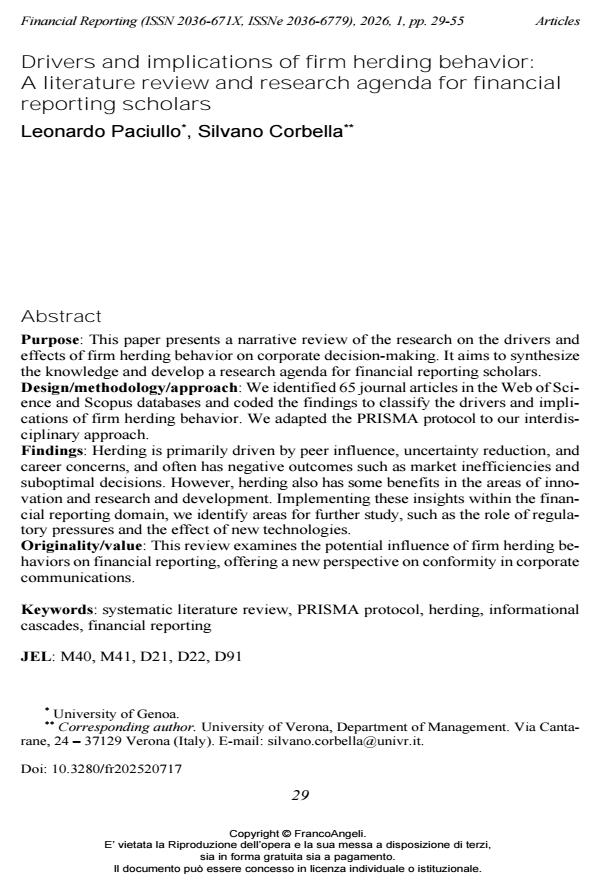
Purpose: This paper presents a narrative review of the research on the drivers and effects of firm herding behavior on corporate decision-making. It aims to synthesize the knowledge and develop a research agenda for financial reporting scholars. Design/methodology/approach: We identified 65 journal articles in the Web of Science and Scopus databases and coded the findings to classify the drivers and implications of firm herding behavior. We adapted the PRISMA protocol to our interdisciplinary approach. Findings: Herding is primarily driven by peer influence, uncertainty reduction, and career concerns, and often has negative outcomes such as market inefficiencies and suboptimal decisions. However, herding also has some benefits in the areas of innovation and research and development. Implementing these insights within the financial reporting domain, we identify areas for further study, such as the role of regulatory pressures and the effect of new technologies. Originality/value: This review examines the potential influence of firm herding behaviors on financial reporting, offering a new perspective on conformity in corporate communications.
Parole chiave:systematic literature review, PRISMA protocol, herding, informational cascades, financial reporting
Jel codes:M40, M41, D21, D22, D91
- Ameye, N., Bughin, J., & van Zeebroeck, N. (2023). How uncertainty shapes herding in the corporate use of artificial intelligence technology. Technovation, 127, 102846.
- Aria, M., & Cuccurullo, C. (2017). bibliometrix: An R-tool for comprehensive science mapping analysis. Journal of Informetrics, 11(4), 959-975.
- Asch, S. E. (1951). Effects of group pressure upon the modification and distortion of judgments. In H. Guetzkow (Ed.), Groups, leadership and men: Research in human relations (pp. 177-190). Carnegie Press.
- Avallone, F. G., Quagli, A., & Ramassa, P. (2022). Interdisciplinary research by accounting scholars: An exploratory study. Financial Reporting, (2), 5-34. DOI: 10.3280/FR2022-002001
- Baddeley, M. (2013). Herding, social influence and expert opinion. Journal of Economic Methodology, 20(1), 35-44. DOI: 10.1080/1350178X.2013.774845
- Banerjee, A. V. (1992). A simple model of herd behavior. The Quarterly Journal of Economics, 107(3), 797-817. DOI: 10.2307/2118364
- Barth, M. E., & Schipper, K. (2008). Financial reporting transparency. Journal of Accounting, Auditing & Finance, 23(2), 173-190. DOI: 10.1177/0148558X0802300203
- Beccalli, E., Bozzolan, S., Laghi, E., & Mattei, M. (2018). Do letters to shareholders inform or mislead? Insights from insider trading. Financial Reporting, 2018(2), 73-109. DOI: 10.3280/FR2018-002004
- Bernardo, A. E., & Welch, I. (2001). On the evolution of overconfidence and entrepreneurs. Journal of Economics & Management Strategy, 10(3), 301-330.
- Beyer, A., Cohen, D. A., Lys, T. Z., & Walther, B. R. (2010). The financial reporting environment: Review of the recent literature. Journal of Accounting and Economics, 50(2), 296-343.
- Bikhchandani, S., Hirshleifer, D., & Welch, I. (1992). A theory of fads, fashion, custom, and cultural change as informational cascades. Journal of Political Economy, 100(5), 992-1026. DOI: 10.1086/261849
- Bouwman, C. H. S., Fuller, K., & Nain, A. S. (2009). Market valuation and acquisition quality: Empirical evidence. Review of Financial Studies, 22(2), 633-679.
- Bozzolan, S., Michelon, G., Mattei, M., & Giornetti, A. (2019). Signing the letter to shareholders: Does the signatory’s role relate to impression management?. Financial Reporting, (1), 37-82. DOI: 10.3280/FR2019-001002
- Brandenburger, A., & Polak, B. (1996). When managers cover their posteriors: Making the decisions the market wants to see. The RAND Journal of Economics, 27(3), 523-541. DOI: 10.2307/2555842
- Camara, O. (2017). Industry herd behaviour in financing decision making. Journal of Economics and Business, 94(6), 32-42.
- Carvalho, A., Sardo, F., & Pacheco, L. (2023). The firms’ debt reversibility trend: An application to a large sample of industrial SMEs. Cogent Economics & Finance, 11(1), 2172802. DOI: 10.1080/23322039.2023.2172802
- Choijil, E., Méndez, C. E., Wong, W.-K., Vieito, J. P., & Batmunkh, M.-U. (2022). Thirty years of herd behavior in financial markets: A bibliometric analysis. Research in International Business and Finance, 59, 101506.
- Chyz, J., Henry, E., Omer, T., & Wu, B. (2023). The effect of significant IPO firms on industry incumbents: Evidence from tax planning. Management Science, 69(10), 6369-6392.
- DeCoster, G. P., & Strange, W. C. (2012). Developers, herding, and overbuilding. The Journal of Real Estate Finance and Economics, 44, 7-35.
- Devenow, A., & Welch, I. (1996). Rational herding in financial economics. European Economic Review, 40(3), 603-615. DOI: 10.1016/0014-2921(95)00073-9
- Dyer, T., Lang, M., & Stice-Lawrence, L. (2017). The evolution of 10-K textual disclosure: Evidence from latent Dirichlet allocation. Journal of Accounting and Economics, 64(2), 221-245.
- European Financial Reporting Advisory Group (2012). Towards a disclosure framework for the notes (Discussion paper). -- https://www.efrag.org/sites/default/files/sites/webpublishing/SiteAssets/121015_Disclosure_Framework_-_FINAL1.pdf.
- Fahr, R., & Irlenbusch, B. (2011). Who follows the crowd - groups or individuals?. Journal of Economic Behavior & Organization, 80(1), 200-209.
- Fang, H., Lee, Y., Shen, C., & Chung, C. (2019). Motivations for loan herding by Chinese banks and its impact on bank performance. China & World Economy, 27(4), 29-52.
- Fang, H., Lu, Y.-C., Shieh, J. C. P., & Lee, Y.-H. (2021). The existence and motivations of irrational loan herding and its impact on bank performance when considering different market periods. International Review of Economics & Finance, 73, 420-443.
- Financial Reporting Council (2011). Cutting clutter: Combating clutter in annual reports (Discussion paper). -- https://media.frc.org.uk/documents/Cutting_Clutter_Combating_clutter_in_annual_reports.pdf.
- Florio, C., & Melloni, G. (2015). Impression management strategies in the letter to shareholders: Empirical evidence from Italian listed firms. In D. Vrontis, Y. Weber, & E. Tsoukatos (Eds.), Proceedings of the 8th Annual Conference of the EuroMed Academy of Business – Innovation, entrepreneurship and sustainable value chain in a dynamic environment (pp. 852-863). Euromed Press.
- Frey, V., & van de Rijt, A. (2021). Social influence undermines the wisdom of the crowd in sequential decision making. Management Science, 67(7), 4273-4286.
- Gabrielli, G., Medioli, A., Andrei, P., & Marchini, P. L. (2022). Accounting and big data: Trends, opportunities and direction for practitioners and researchers. Financial Reporting, (2), 89-112. DOI: 10.3280/FR2022-002004
- Gai, P. S. (1997). International bank lending to LDCs: An information based approach. International Journal of Finance & Economics, 2(1), 59-71.
- Hasegawa, N., Kim, H., & Yasuda, Y. (2017). The adoption of stock option plans and their effects on firm performance during Japan’s period of corporate governance reform. Journal of the Japanese and International Economies, 44, 13-25.
- Hertwig, M. (2012). Institutional effects in the adoption of e-business-technology: Evidence from the German automotive supplier industry. Information and Organization, 22(4), 252-272.
- Ho, B., & Liu, P. (2015). Herd journalism: Investment in novelty and popularity in markets for news. Information Economics and Policy, 31, 33-46.
- Hoberg, G., & Lewis, C. M. (2013). Do fraudulent firms engage in disclosure herding? (Vanderbilt Owen Graduate School of Management Research Paper No. 2298302).
- Holmes, P., Kallinterakis, V., & Ferreira, M. P. L. (2013). Herding in a concentrated market: A question of intent. European Financial Management, 19(3), 497-520.
- Homburg, C., Wieseke, J., & Kuehnl, C. (2010). Social influence on salespeople’s adoption of sales technology: A multilevel analysis. Journal of the Academy of Marketing Science, 38(2), 159-168.
- Hoogervorst, H. (2013, June 27). IASB chair’s speech: Breaking the boilerplate. International Financial Reporting Standards Foundation. -- https://www.ifrs.org/news-and-events/news/2013/06/iasb-chairs-speech-breaking-the-boilerplate/.
- Horvath, M., Schivardi, F., & Woywode, M. (2001). On industry life-cycles: Delay, entry, and shakeout in beer brewing. International Journal of Industrial Organization, 19(7), 1023-1052. DOI: 10.1016/S0167-7187(01)00062-5
- Im, H. J., Liu, J., & Park, Y. J. (2021). Policy uncertainty and peer effects: Evidence from corporate investment in China. International Review of Financial Analysis, 77, 101834.
- Johnston, J. A., & Zhang, J. H. (2021). Auditor style and financial reporting similarity. Journal of Information Systems, 35(1), 79-99.
- Kameda, T., & Hastie, R. (2015). Herd behavior. In R. A. Scott, M. C. Buchmann, & S. M. Kosslyn (Eds.), Emerging trends in the social and behavioral sciences: An interdisciplinary, searchable, and linkable reference for the 21st century (pp. 1-14). John Wiley & Sons.
- Kennedy, R. E. (2002). Strategy fads and competitive convergence: An empirical test for herd behavior in prime-time television programming. Journal of Industrial Economics, 50(1), 57-84. DOI: 10.1111/1467-6451.00168
- Khanna, N., & Mathews, R. D. (2011). Can herding improve investment decisions?. The RAND Journal of Economics, 42(1), 150-174.
- Ko, H., & Moon, W. J. (2012). Contracting foreign exchange rate risks: A behavioral law and economics perspective on KIKO forward contracts. European Journal of Law and Economics, 34(2), 391-412.
- Komalasari, P. T., Asri, M., Purwanto, B. M., & Setiyono, B. (2022). Herding behaviour in the capital market: What do we know and what is next? Management Review Quarterly, 72, 745-787.
- Kübler, D., & Weizsäcker, G. (2003). Information cascades in the labor market. Journal of Economics, 80(3), 211-229.
- Li, T., Chen, H., Liu, W., Yu, G., & Yu, Y. (2023). Understanding the role of social media sentiment in identifying irrational herding behavior in the stock market. International Review of Economics & Finance, 87, 163-179.
- Li, X., Kauffman, R. J., Yu, F., & Zhang, Y. (2014). Externalities, incentives and strategic complementarities: Understanding herd behavior in IT adoption. Information Systems and e-Business Management, 12(3), 443-464. s10257-013-0231-2.
- Liao, Y.-H., Sang, T.-S., & Tsai, Y.-T. (2022). Do information sources matter in corporate tax avoidance? The roles of peer effects and director interlocks. Review of Quantitative Finance and Accounting, 59(1), 339-382.
- Litimi, H. (2017). Herd behavior in the French stock market. Review of Accounting and Finance, 16(4), 497-515. DOI: 10.1108/RAF-11-2016-0188
- Liu, H., Liu, S., Li, J., & Wu, P. (2021). An empirical study of Chinese listed firms’ herd behaviour in cross-border mergers and acquisitions. Accounting & Finance, 61(5), 6295-6331.
- Liu, H., Wang, Y., & Zhang, L. (2022). The herd effect and cross-border mergers and acquisitions by Chinese firms. Emerging Markets Finance and Trade, 58(6), 1537-1549. DOI: 10.1080/1540496X.2021.1903866
- Macchioni, R., Prisco, M., & Allini, A. (2022). The role of the Big Four audit firms and the legal system in non-GAAP comparability. Financial Reporting, 1, 79-16. DOI: 10.3280/FR2022-001003
- Margaretic, P., Cifuentes, R., & Carreño, J. G. (2021). Banks’ interconnections and peer effects: Evidence from Chile. Research in International Business and Finance, 58, 101438.
- Martins, A. M., Serra, A. P., Vitorino Martins, F., & Stevenson, S. (2020). House price dynamics and bank herding: European empirical evidence. Journal of Real Estate Research, 42(3), 365-396. DOI: 10.1080/08965803.2020.1840897
- McMullin, J. L. (2016). Can I borrow your footnotes? Footnote boilerplate’s learning externality (Kelley School of Business Research Paper No. 2014-13).
- Melissas, N. (2005). Herd behaviour as an incentive scheme. Economic Theory, 26(3), 517-536.
- Minehart, D., & Scotchmer, S. (1999). Ex post regret and the decentralized sharing of information. Games and Economic Behavior, 27(1), 114-131.
- Nakagawa, R. (2022). Bank herding in loan markets: Evidence from geographical data in Japan. International Review of Finance, 22(1), 72-89.
- Nakagawa, R., Oiwa, H., & Takeda, F. (2012). The economic impact of herd behavior in the Japanese loan market. Pacific-Basin Finance Journal, 20(4), 600-613.
- Nakagawa, R., & Uchida, H. (2011). Herd behaviour by Japanese banks after financial deregulation. Economica, 78(312), 618-636.
- Oberholzer-Gee, F. (2008). Nonemployment stigma as rational herding: A field experiment. Journal of Economic Behavior & Organization, 65(1), 30-40.
- Orihara, M., & Eshraghi, A. (2022). Corporate governance compliance and herding. International Review of Financial Analysis, 80, 102029.
- Palley, T. I. (1995). Safety in numbers: A model of managerial herd behavior. Journal of Economic Behavior & Organization, 28(3), 443-450. DOI: 10.1016/0167-2681(95)00046-1
- Pavlovic-Höck, D. N. (2022). Herd behaviour along the consumer buying decision process - Experimental study in the mobile communications industry. Digital Business, 2(1), 100018.
- Pecchenino, R. A. (1998). Risk averse bank managers: Exogenous shocks, portfolio reallocations and market spillovers. Journal of Banking & Finance, 22(2), 161-174. DOI: 10.1016/S0378-4266(97)00050-2
- Peres, Y., Racz, M. Z., Sly, A., & Stuhl, I. (2018). How fragile are information cascades?. arXiv.
- Pinheiro-Alves, R. (2011). Behavioural influences in Portuguese foreign direct investment. The Journal of Socio-Economics, 40(4), 394-03.
- Povel, P., Sertsios, G., Kosova, R., & Kumar, P. (2016). Boom and gloom. Journal of Finance, 71(5), 2287-2332.
- Quagli, A. (2004). Comunicare il futuro: L’informativa economico-finanziaria di tipo previsionale delle società quotate Italiane. [Communicating the future: The economic and financial forecasting information of Italian listed companies]. Milano: FrancoAngeli.
- Ridley, D. B. (2008). Herding versus hotelling: Market entry with costly information. Journal of Economics & Management Strategy, 17(3), 607-631.
- Rind, A. A., Abbassi, W., Bigelli, M., & Rouatbi, W. (2023). Industry influence on firms’ R&D and innovation. Journal of International Financial Management & Accounting, 34(2), 162-210.
- Rind, A. A., Akbar, S., Boubaker, S., Lajili-Jarjir, S., & Mollah, S. (2022). The role of peer effects in corporate employee welfare policies. British Journal of Management, 33(3), 1609-1631. DOI: 10.1111/1467-8551.12513
- Scott, R., Skinner, A. N., & Valentine, K. (2024). The disclosure quality consequences of copying standard-setter guidance. Review of Accounting Studies, 29, 770-808.
- Simon, H. A. (1990). A mechanism for social selection and successful altruism. Science, 250(4988), 1665-1668.
- Smith, L., & Sørensen, P. (2000). Pathological outcomes of observational learning. Econometrica, 68(2), 371-398. DOI: 10.1111/1468-0262.00113
- Spyrou, S. (2013). Herding in financial markets: A review of the literature. Review of Behavioral Finance, 5(2), 175-194. DOI: 10.1108/RBF-02-2013-0009
- Subrahmanyam, A. C. V., & Raja Sethu Durai, S. (2023). Does ownership matter in bank herding behavior? Evidence from India. Journal of Social and Economic Development, 25(Suppl. 1), 49-71.
- Sun, H. (2013). A longitudinal study of herd behavior in the adoption and continued use of technology. MIS Quarterly, 37(4), 1013-1041. 2013/37.4.02.
- Tran, H. T., Santarelli, E., & Zaninotto, E. (2015). Efficiency or bounded rationality? Drivers of firm diversification strategies in Vietnam. Journal of Evolutionary Economics, 25(5), 983-1010.
- Tran, V. T., Nguyen, H., & Lin, C. T. (2017). Herding behaviour in the Australian loan market and its impact on bank loan quality. Accounting & Finance, 57(4), 1149-1176.
- Tse, S., & Tucker, J. W. (2010). Within-industry timing of earnings warnings: Do managers herd? Review of Accounting Studies, 15(4), 879-914.s11142-009-9117-4.
- Uchida, H., & Nakagawa, R. (2007). Herd behavior in the Japanese loan market: Evidence from bank panel data. Journal of Financial Intermediation, 16(4), 555-583.
- Wang, F., Hu, W., Liu, L., & Yang, L. (2023). U-shaped relationship between managerial herd behavior and corporate financialization with the moderating effect of corporate governance: Evidence from China. Journal of Business Economics and Management, 24(5), 939-959.
- Wu, J., Yao, Y., Chen, M., & Jeon, B. N. (2020). Economic uncertainty and bank risk: Evidence from emerging economies. Journal of International Financial Markets, Institutions and Money, 68, 101242.101242.
- Yang, W., & Loang, O. K. (2024). Systematic literature review: Behavioural biases as the determinants of herding. In R. El Khoury (Ed.), Technology-driven business innovation: Unleashing the digital advantage (Vol. 1, pp. 79-92). Springer Nature Switzerland.
Leonardo Paciullo, Silvano Corbella, Drivers and implications of firm herding behavior: A literature review and research agenda for financial reporting scholars in "FINANCIAL REPORTING" 1/2026, pp 29-55, DOI: 10.3280/fr202520717