Problems of drug research: The case of "Study 329".

Journal title PSICOTERAPIA E SCIENZE UMANE
Author/s Paolo Migone
Publishing Year 2015 Issue 2015/4
Language Italian Pages 6 P. 589-594 File size 50 KB
DOI 10.3280/PU2015-004003
DOI is like a bar code for intellectual property: to have more infomation click here

Below, you can see the article first page

If you want to buy this article in PDF format, you can do it, following the instructions to buy download credits
Article preview

FrancoAngeli is member of Publishers International Linking Association, Inc (PILA), a not-for-profit association which run the CrossRef service enabling links to and from online scholarly content.

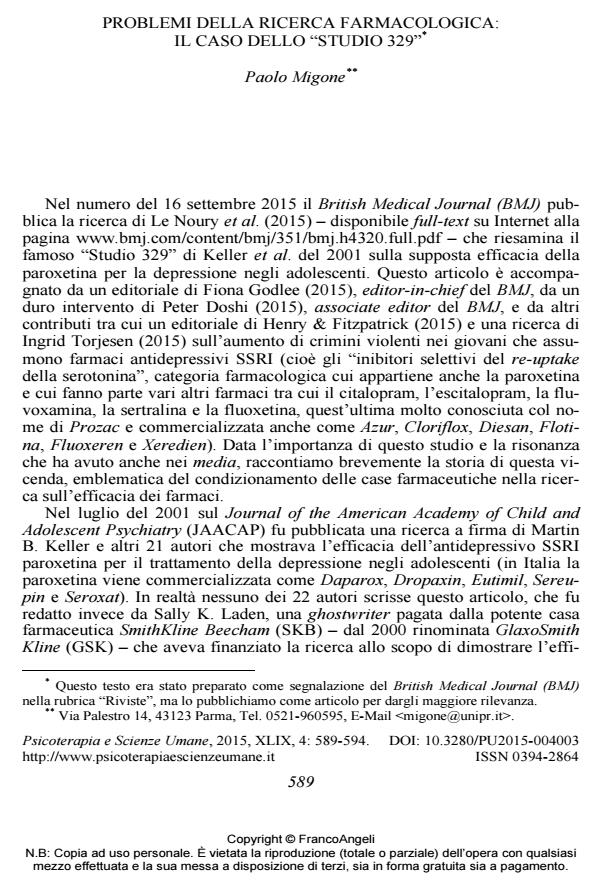
On September 16, 2015, the British Medical Journal (BMJ) published the reanalysis, authored by Le Noury et al., of the infamous "Study 329", i.e., the randomized controlled trial (RCT) by Keller et al. of 2001 on the effects of paroxetine and imipramine for major depression in adolescents, that had concluded that paroxetine was «generally well tolerated and effective»ۚ. This reanalysis, instead, on the basis of the same data has reached the opposite conclusion, i.e., that paroxetine is not effective in the treatment of major depression in adolescents, and there is a clinically significant increase in harms, including serious, severe, and suicide related adverse events. The manufacturer of paroxetine, the GlaxoSmithKline (GSK) pharmaceutical company, had in fact been sued for fraud and had to pay a $3 billion fine.

Keywords: Paroxetine, drug research, fraud, pharmaceutical companies, GlaxoSmithKline (GSK)

  1. Internet: Driessen E., Hollon S. D., Bockting C. L. H., Cuijpers P. & Turner E. H. (2015). Does publication bias in flate the apparent efficacy of psychological treatment for major depressive disorder? A systematic review and meta-analysis of US National Institutes of Health-fundedtrials. PLoSONE, 10,9 DOI: 10.1371/journal.pone.0137864
  2. (2015). Restoring Study 329: Efficacy and harms of paroxetine and imipramine in treatment of major depression in adolescence. BMJ, 351: h4320. DOI: 10.1136/bmj.h4320
  3. Loder E. (2013). Sharing data from clinical trials: Where we are and what lies ahead. BMJ, 347: f4794. DOI: 10.1136/bmj.f4794
  4. Loder E., Godlee F., Barbour V. & Winker M. (2013). Restoring the integrity of the clinical trial evidence base. BMJ, 346: f3601. DOI: 10.1136/bmj.f3601
  5. Melander H., Ahlqvist-Rastad J., Meijer G. & Beermann B. (2003). Evidence b(i)ased medicine. Selective reporting from studies sponsored by pharmaceutical industry: Review of
  6. studies in new drug applications. BMJ, 326: 1171. DOI: 10.1136/bmj.326.7400.1171
  7. Migone P. (2005). Farmaci antidepressivi nella pratica psichiatrica: efficacia reale. Psicoterapia e Scienze Umane, XXXIX, 3: 312-322.
  8. Migone P. (2009). Quanto sono efficaci i farmaci antidepressivi? Il Ruolo Terapeutico, 112: 45-56. Internet Migone P. (2010). Evidence-Based Medicine o Evidence-B(i)ased Medicine? Ancora sulla efficacia dei farmaci antidepressivi. Psichiatri Oggi, XII, 3: 15-17.
  9. Migone P. (2013a). La congiura del silenzio. I farmaci antidepressivi sono veramente efficaci? Psicologia Contemporanea, XL, 238 (luglio-agosto): 20-25.
  10. Migone P. (2013b). Scheda: “Irving Kirsch, I farmaci antidepressivi: il crollo di un mito. Dalle pillole della felicità alla cura integrata (2009). Milano: Tecniche Nuove, 2012; Robert Whitaker, Indagine su un’epidemia. Lo straordinario aumento delle disabilità psichiatriche nell’epoca del boom degli psicofarmaci (2010). Roma: Fioriti, 2013”. Psicoterapia e Scienze Umane, XLVII, 3: 526-527. DOI: 10.3280/PU2013-003007
  11. Migone P. (2014). Prefazione. In: Herzberg D., Le pillole della felicità in America. Dal Miltown al Prozac (2009). Roma: L’Asino d’Oro, 2014, pp. IX-XXIV.
  12. Newman M. (2010). The rules of retraction. BMJ, 341: c6985. DOI: 10.1136/bmj.c6985
  13. Prayle A.P., Hurley M.H. & Smyth A.R. (2012). Compliance with mandatory reporting of clinical trial results on ClinicalTrials.gov: Cross sectional study. BMJ, 344: d7373. DOI: 10.1136/bmj.d7373
  14. Rubiales A.S. (2013). Who is responsible for publishing the results of old trials? BMJ, 347: f7199. DOI: 10.1136/bmj.f7199
  15. Schulz K.F. et al. (2010). CONSORT 2010 Statement: Updated guidelines for reporting parallel group randomised trials. BMJ, 340: c332. DOI: 10.1136/bmj.c332
  16. Smith R. (1997). Authorship is dying: Long live contributorship. BMJ, 315: 696. DOI: 10.1136/bmj.315.7110.696
  17. Smith R., Gøtzsche P.C. & Groves T. (2014). Should journals stop publishing research funded by the drug industry? BMJ, 348: g171. DOI: 10.1136/bmj.g171
  18. Spagnoli A. (2012). “British Medical Journal (BMJ), 2012, Volume 344, n. 7845 (25 febbraio)”. Psicoterapia e Scienze Umane, XLVI, 2: 312-314. DOI: 10.3280/PU2012-002009
  19. Taylor D., Sparshatt A., Varma S. & Olofinjana O. (2014). Antidepressant efficacy of agomelatine: meta-analysis of published and unpublished studies. BMJ, 348: g1888. DOI: 10.1136/bmj.g1888
  20. Torjesen I. (2015). Study links SSRIs to violent crime in young adults. BMJ, 351: h4945. DOI: 10.1136/bmj.h4945
  21. Tucker M.E. (2013). How should clinical trial data be shared? BMJ, 347: f4465. DOI: 10.1136/bmj.f4465
  22. Chan A.-W. et al. (2013). SPIRIT 2013 explanation and elaboration: Guidance for protocols of clinical trials. British Medical Journal (BMJ), 346: e7586. DOI: 10.1136/bmj.e7586
  23. Doshi P. (2015). No correction, no retraction, no apology, no comment: Paroxetine trial reanalysis raises questions about institutional responsibility. BMJ, 351: h4629. DOI: 10.1136/bmj.h4629
  24. Doshi P., Jones M. & Jefferson T. (2012). Rethinking credible evidence synthesis. BMJ, 344: d7898. DOI: 10.1136/bmj.d7898
  25. Doshi P., Dickersin K. & Healy D. (2013). Restoring invisible and abandoned trials: A call for people to publish the findings. BMJ, 346: f2865. DOI: 10.1136/bmj.f2865
  26. Ebrahim S., Sohani Z.N., Montoya L. & Agarwal A. (2014). Reanalyses of randomized clinical trial data. Journal of the American Medical Association (JAMA), 312, 10: 1024-1032. DOI: 10.1001/jama.2014.9646
  27. Godlee F.(2013a). In praise of informed scepticism.BMJ,346: f3980. DOI: 10.1136/bmj.f3980
  28. Godlee F. (2013b). Editor’s reply to Smith. BMJ, 347: f6859. DOI: 10.1136/bmj.f6859
  29. Godlee F. (2015). Study 329. BMJ, 351: h4973. DOI: 10.1136/bmj.h4973
  30. Hawkes N. (2013). Independent researchers should have right to publish trial results if original researchers don’t, campaigners say. BMJ, 346: f3857. DOI: 10.1136/bmj.f3857
  31. Hendrick R. (2011). Ghosts in the machine. BMJ, 343: d7860. DOI: 10.1136/bmj.d7860
  32. Henry D. & Fitzpatrick T. (2015). Liberating the data from clinical trials. BMJ, 351: h4601. DOI: 10.1136/bmj.h4601
  33. Hrynaszkiewicz I., Norton M.L., Vickers A.J. & Altman D.G. (2010). Preparing raw clinical data for publication: Guidance for journal editors, authors, and peer reviewers. BMJ, 340: c181. DOI: 10.1136/bmj.c181
  34. Jureidini J.N. & Nardo J.M. (2014). Inadequacy of remote desktop interface for independent reanalysis of data from drug trials. BMJ, 349: g4353. DOI: 10.1136/bmj.g4353
  35. Keller M.B. et al. (2001). Efficacy of paroxetine in the treatment of adolescent major depression: A randomized, controlled trial. Journal of the American Academy of Child and Adolescent Psychiatry (JAACAP), 40, 7: 762-772. DOI: 10.1097/00004583-200107000-00010
  36. Le Noury J., Nardo J.M., Healy D., Jureidini J., Raven M., Tufanaru C. & Abi-Jaoude E.

  • Sul rinnovamento della psicoanalisi Giorgio Meneguz, in PSICOTERAPIA E SCIENZE UMANE 2/2023 pp.213
    DOI: 10.3280/PU2023-002003
  • Dove sono le evidenze della terapia "basata sulle evidenze"? Jonathan Shedler, in PSICOTERAPIA E SCIENZE UMANE 3/2018 pp.383
    DOI: 10.3280/PU2018-003003

Paolo Migone, Problemi della ricerca farmacologica: il caso dello "Studio 329" in "PSICOTERAPIA E SCIENZE UMANE" 4/2015, pp 589-594, DOI: 10.3280/PU2015-004003