Psychotherapy and Artificial Intelligence: Possibility or Threat?
Journal title RIVISTA DI PSICOTERAPIA RELAZIONALE
Author/s Gianluca Resicato
Publishing Year 2026 Issue 2026/63
Language Italian Pages 19 P. 25-43 File size 152 KB
DOI 10.3280/PR2026-063002
DOI is like a bar code for intellectual property: to have more infomation
click here
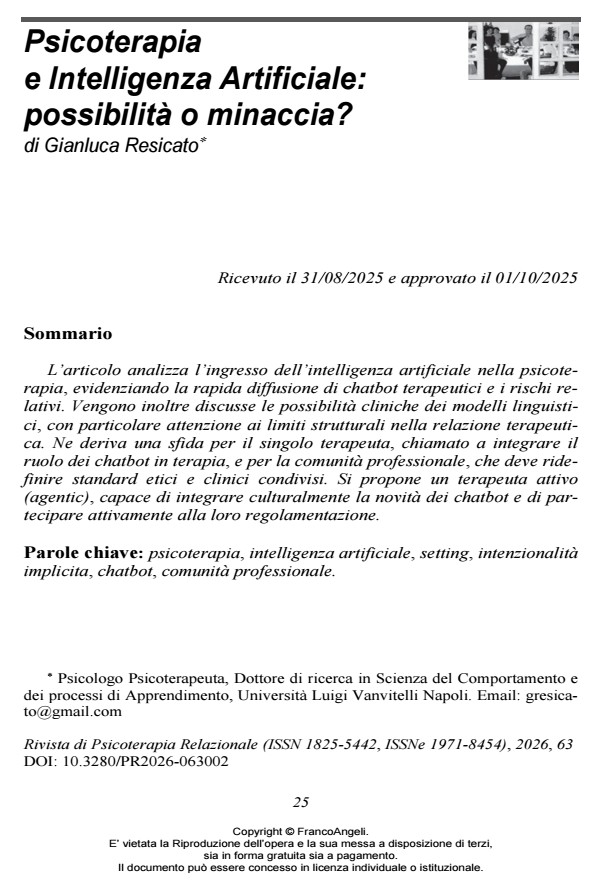
Below, you can see the article first page
If you want to buy this article in PDF format, you can do it, following the instructions to buy download credits
FrancoAngeli is member of Publishers International Linking Association, Inc (PILA), a not-for-profit association which run the CrossRef service enabling links to and from online scholarly content.
The article examines the integration of artificial intelligence in psychotherapy, highlighting the rapid spread of therapeutic chatbots and related risks. It also discusses the clinical potential of language models, focusing on their structural limits in therapeutic relationships. This creates a challenge for therapists, called to integrate chatbots within therapy, and for the professional community, which must redefine shared ethical and clinical standards. An active (agentic) therapist is proposed, able to integrate chatbots culturally and contribute to their regulation.
Keywords: psychotherapy, artificial intelligence, setting, implicit intentionality, chatbots, professional community.
- American Psychological Association (APA) (2024). Guidelines on the use of AI in psychological practice. Washington, DC: Author.
- Andolfi M. (2003). Il terapeuta familiare. Roma: Carocci.
- Balan R., Dobrean A., Poetar C.R. (2024). Use of automated conversational agents in improving young population mental health: A scoping review. npj Digital Medicine, 7: 75.
- Barak A., Hen L., Boniel-Nissim M., Shapira N. (2008). A comprehensive review and a meta-analysis of the effectiveness of internet-based psychotherapeutic interventions. Journal of Technology in Human Services, 26: 109-160.
- Beatty L., Lambert S., Cheung Y.B., Jibb L., Aggarwal J. (2022). Evaluating the therapeutic alliance with a free-text CBT conversational agent (Wysa): A mixed-methods study. Frontiers in Digital Health, 4:
- Beebe B., Lachmann F.M. (2002). Infant research and adult treatment: Co-constructing interactions. Hillsdale, NJ: The Analytic Press (trad. it.: La mente interattiva. Dall’infanzia alla psicoanalisi. Milano: Raffaello Cortina, 2008).
- Bender E.M., Gebru T., McMillan-Major A., Shmitchell S. (2021). On the dangers of stochastic parrots: Can language models be too big? In Proceedings of the 2021 ACM Conference on Fairness, Accountability, and Transparency (FAccT ‘21) (pp. 610–623). New York: ACM.
- Boscolo L., Cecchin G., Hoffman L., Penn P. (1987). Milano: La terapia sistemica in evoluzione. Torino: Bollati Boringhieri.
- Boscolo L., Bertrando P. (1993). La terapia sistemica individuale. Torino: Bollati Boringhieri.
- Bubeck S., Chandrasekaran V., Eldan R., Gehrke J., Horvitz E., Kamar E., Lee P., Lee Y.T., Li Y., Lundberg S., Nori H., Palangi H., Ribeiro M.T., Zhang Y., (2023). Sparks of artificial general intelligence: Early experiments with GPT-4. arXiv preprint arXiv:2303.12712.
- Cecchin G. (1992). Irreverence: A strategy for therapists’ survival. London: Karnac.
- Cheng J., Tsai C. (2017). Therabot: Development of an empathic chatbot for mental health support. In Proceedings of the 2017 CHI Conference Extended Abstracts on Human Factors in Computing Systems (pp. 1235–1242). New York: ACM.
- Consiglio Nazionale dell’Ordine degli Psicologi (CNOP) (2023). Linee di indirizzo sull’uso dell’intelligenza artificiale in psicologia. Roma: CNOP.
- Draelos R.L., Afreen S., Blasko B., Brazile T.L., Chase N., Desai D.P., Evert J., Gardner H.L., Herrmann L., House A., Vaikom K., Stephanie K., Kavan M., Khemani K., Koire A., McDonald L.M., Rabeeah Z., Shah A. (2026). Large language models provide unsafe answers to patient-posed medical questions. NPJ Digital Medicine, 9: 241.
- Elkaïm M. (2004). The feelings of the psychotherapist: Systemic approach and resonance. Journal of Family Therapy, 26: 123-140.
- Epley N., Waytz A., Cacioppo J.T. (2007). On seeing human: A three-factor theory of anthropomorphism. Psychological Review, 114: 864-886. DOI: 10.1037/0033-295X.114.4.86
- Eubanks C.F., Muran J.C., Safran J.D. (2018). Alliance rupture repair: A meta-analysis. Psychotherapy, 55: 508-519.
- European Parliament & Council (2024). Regulation (EU) 2024/1689 of the European Parliament and of the Council of 12 July 2024 laying down harmonised rules on Artificial Intelligence (Artificial Intelligence Act). Official Journal of the European Union. https://eur-lex.europa.eu/eli/reg/2024/1689/oj
- Fang C.M., Liu A.R., Danry V., Lee E., Chan S.W.T., Pataranutaporn P., Maes P., Phang J., Lampe M., Ahmad L., Agarwal S. (2025). How AI and human behaviors shape psychosocial effects of extended chatbot use: A longitudinal randomized controlled study. arXiv preprint arXiv:2503.17473, 1-24.
- Stanford Institute for Human-Centered AI (HAI) (2025). Safety and appropriateness of therapy chatbots: Report 2025. Stanford: Stanford University.
- Fiske A., Henningsen P., Buyx A. (2019). Your robot therapist will see you now: Ethical implications of embodied artificial intelligence in psychiatry, psychology, and psychotherapy. Journal of Medical Internet Research, 21: e13216. DOI: 10.2196/13216
- Flückiger C., Del Re A.C., Wampold B.E., Horvath A.O. (2018). The alliance in adult psychotherapy: A meta-analytic synthesis. Psychotherapy, 55: 316-340.
- Fulmer R., Joerin A., Gentile B., Lakerink L., Rauws M. (2018). Using psychological artificial intelligence (Tess) to relieve symptoms of depression and anxiety: Randomized controlled trial. JMIR Mental Health, 5: 64.
- Gallagher S. (2000). Philosophical conceptions of the self: Implications for cognitive science. Trends in Cognitive Sciences, 4: 14-21.
- Gaffney H., Mansell W., Tai S. (2019). Conversational agents in the treatment of mental health problems: Systematic review and meta-analyses. BMJ Mental Health, 25: 27-37. DOI: 10.2196/1416
- Grand View Research (2024). Mental health apps market size, share & trends analysis report, 2024–2033. San Francisco: Grand View Research.
- Hertz D., Raveendhran R. (2023). Large language models and the psychology of persuasion. Harvard Business Review, 101: 88-97.
- High-Level Expert Group on AI (HLEG) (2019). Ethics Guidelines for Trustworthy AI. Brussels: European Commission.
- Li J., Ma J., Zhang H., Sun Q. (2023). The efficacy of conversational agents for mental health: A meta-analysis. Journal of Affective Disorders, 342: 10-22. DOI: 10.2196/4386
- Lini G., Bertrando P. (2020). Finding one’s place: Emotions and positioning in systemic-dialogical therapy. Journal of Family Therapy, 42: 498-514.
- Lopez A., Schwenk S., Schneck C.D., Griffin R.J., Mishkind M.C. (2019). Technology-based mental health treatment and the impact on the therapeutic alliance. Current Psychiatry Reports, 21: 76.
- Mozilla Foundation (2023). Privacy Not Included: Mental health apps. Mountain View. CA: Mozilla Foundation.
- NICE (2025). Early Value Assessment: Wysa for depression and anxiety in adults. London: National Institute for Health and Care Excellence.
- Osservatorio Artificial Intelligence - Politecnico di Milano (2024). Il mercato dell’AI in Italia 2024. Milano: Politecnico di Milano.
- Pereira A.A.C., Destro J.R., Bernuci M.P., Garcia L.F., Lucena T.F.R. (2020). Effects of a WhatsApp-delivered education intervention to enhance breast cancer knowledge in women: Mixed-methods study. JMIR mHealth and uHealth, 8, DOI: 10.2196/17430
- Politecnico di Milano - Osservatorio Sanità Digitale (2024). Sanità digitale 2024: Cittadini e generative AI in sanità. Milano: Politecnico di Milano.
- Przybylski A.K., Murayama K., DeHaan C.R., Gladwell V. (2013). Motivational, emotional, and behavioral correlates of fear of missing out. Computers in Human Behavior, 29: 1841-1848.
- Rollwage M., Habicht J., Juchems K., Carrington B., Hauser T.U., Harper R. (2024). Conversational AI facilitates mental health assessments and is associated with improved recovery rates. BMJ Innovations, 10: 1-2.
- Safran J.D., Muran J.C. (2000). Negotiating the therapeutic alliance: A relational treatment guide. New York: Guilford Press.
- Salvi F., Ribeiro M.H., Gallotti R., West R. (2025). On the conversational persuasiveness of GPT-4. Nature Human Behaviour, 9.
- Schore A.N. (2012). The science of the art of psychotherapy. New York: W. W. Norton (trad. it.: Affetti e regolazione dello sviluppo del sé. Milano: Raffaello Cortina, 2008).
- Stern D.N. (1985). The interpersonal world of the infant. New York: Basic Books (trad it: Il mondo interpersonale del bambino. Torino: Bollati Boringhieri, 1987).
- Tomm K. (1987). Interventive interviewing: Part III. Intending to ask lineal, circular, reflexive, or strategic questions. Family Process, 26: 167-183.
- Turkle S. (2011). Alone together: Why we expect more from technology and less from each other. New York: Basic Books.
- Vaswani, A., Shazeer, N., Parmar, N., Uszkoreit, J., Jones, L., Gomez, A. N., Kaiser, L., & Polosukhin, I. (2017). Attention is all you need. In Advances in Neural Information Processing Systems (Vol. 30, pp.5998–6008). Curran Associates.
- Wind T.R., Rijkeboer M., Andersson G., Riper H. (2020). The COVID-19 pandemic: The “black swan” for mental health care and a turning point for e-health. Internet Interventions, 20: 100317.
- Zhong W., Luo J., Zhang H. (2024). The therapeutic effectiveness of artificial intelligence-based chatbots in alleviation of depressive and anxiety symptoms in short-course treatments: A systematic review and meta-analysis. Journal of Affective Disorders, 356: 459-469.
- Zhou X., Li Y. (2023). Cognitive empathy in large language models: Capabilities and limits. Computational Linguistics, 49: 987-1012.
Gianluca Resicato, Psicoterapia e Intelligenza Artificiale: possibilità o minaccia? in "RIVISTA DI PSICOTERAPIA RELAZIONALE " 63/2026, pp 25-43, DOI: 10.3280/PR2026-063002