Conoscenze a riguardo di HIV/AIDS e abitudini rispetto ai comportamenti a rischio di trasmissione: un’indagine su un campione italiano

Titolo Rivista PSICOLOGIA DELLA SALUTE
Autori/Curatori Sofia Falaschi, Paolo Antonelli, Gioele Salvatori, Daniel Giunti, Davide Dèttore
Anno di pubblicazione 2026 Fascicolo 2026/1
Lingua Italiano Numero pagine 21 P. 57-77 Dimensione file 162 KB
DOI 10.3280/PDS2026-001005
Il DOI è il codice a barre della proprietà intellettuale: per saperne di più clicca qui

Qui sotto puoi vedere in anteprima la prima pagina di questo articolo.

Se questo articolo ti interessa, lo puoi acquistare (e scaricare in formato pdf) seguendo le facili indicazioni per acquistare il download credit. Acquista Download Credits per scaricare questo Articolo in formato PDF
Anteprima articolo

FrancoAngeli è membro della Publishers International Linking Association, Inc (PILA), associazione indipendente e non profit per facilitare (attraverso i servizi tecnologici implementati da CrossRef.org) l’accesso degli studiosi ai contenuti digitali nelle pubblicazioni professionali e scientifiche.

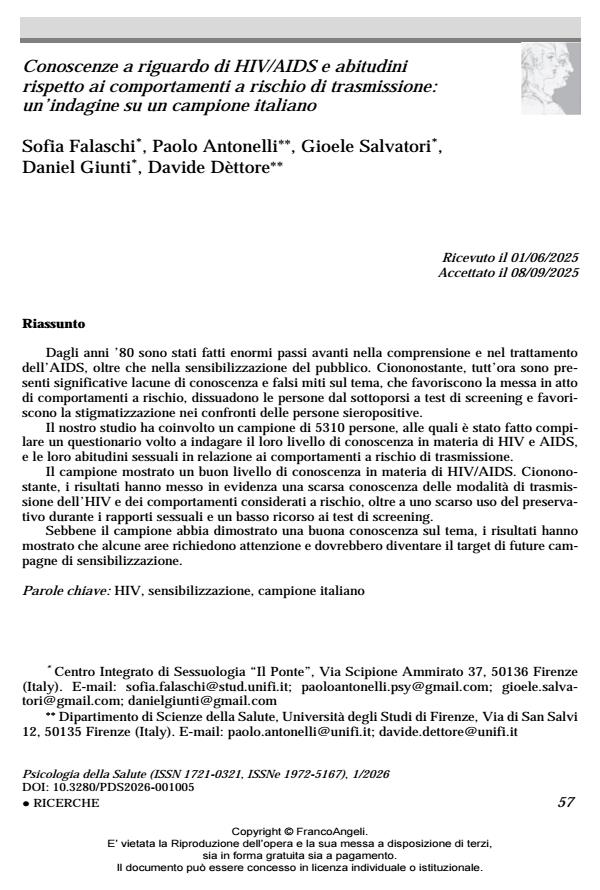
Dagli anni ’80 sono stati fatti enormi passi avanti nella comprensione e nel trattamento dell’AIDS, oltre che nella sensibilizzazione del pubblico. Ciononostante, tutt’ora sono presenti significative lacune di conoscenza e falsi miti sul tema, che favoriscono la messa in atto di comportamenti a rischio, dissuadono le persone dal sottoporsi a test di screening e favoriscono la stigmatizzazione nei confronti delle persone sieropositive. Il nostro studio ha coinvolto un campione di 5310 persone, alle quali è stato fatto compilare un questionario volto a indagare il loro livello di conoscenza in materia di HIV e AIDS, e le loro abitudini sessuali in relazione ai comportamenti a rischio di trasmissione. Il campione mostrato un buon livello di conoscenza in materia di HIV/AIDS. Ciononostante, i risultati hanno messo in evidenza una scarsa conoscenza delle modalità di trasmissione dell’HIV e dei comportamenti considerati a rischio, oltre a uno scarso uso del preservativo durante i rapporti sessuali e un basso ricorso ai test di screening. Sebbene il campione abbia dimostrato una buona conoscenza sul tema, i risultati hanno mostrato che alcune aree richiedono attenzione e dovrebbero diventare il target di future campagne di sensibilizzazione.

Parole chiave:HIV, sensibilizzazione, campione italiano

  1. Abel, T. & Werner, M. (2003). HIV risk behaviour of older persons. The European Journal of Public Health, 13(4): 350-352.
  2. Anokye, R., Acheampong, E., Budu-Ainooson, A., Obeng, E. I., Tetteh, E., Acheampong, Y. S. & Nettey-Marbell, C. E. (2019). Knowledge of HIV/AIDS among older adults (50 years and above) in a peri-urban setting: a descriptive cross-sectional study. BMC geriatrics, 19(1): 1-8.
  3. Bruce, K. E. & Walker, L. J. (2001). College students’ attitudes about AIDS: 1986 to 2000. AIDS Education and Prevention, 13(5): 428-437.
  4. Capron, D. W., Gonzalez, A., Parent, J., Zvolensky, M. J. & Schmidt, N. B. (2012). Suicidality and anxiety sensitivity in adults with HIV. AIDS patient care and STDs, 26(5): 298-303.
  5. Centers for Disease Control and Prevention (1996). AIDS among persons aged greater than or equal to 50 years. Morbidity and Mortality Weekly Report, 47(2): 21-29.
  6. Cohen, J. (2013). Statistical power analysis for the behavioral sciences. New York: Routledge.
  7. Coeytaux, K., Kramer, M. R. & Sullivan, P. S. (2014). HIV testing among United States high school students at the state and national level, Youth Risk Behavior Survey 2005–2011. Springerplus, 3(1): 1-11. DOI: 10.1186/2193-1801-3-20
  8. Colpani, A., De Vito, A., Zauli, B., Menzaghi, B., Calcagno, A., Celesia, B. M., Ceccarelli, M., Nunnari, G., De Socio, G. V., Di Biagio, A., Leoni, N., Angioni, G., Giambenedetto, S. D., D’Ettorre, G., Babudieri, S. & Madeddu, G. (2024). Knowledge of Sexually Transmitted Infections and HIV among People Living with HIV: Should We Be Concerned? Healthcare, 12(4): 417.
  9. Delacre, M., Lakens, D. & Leys, C. (2017). Why psychologists should by default use Welch’s t-test instead of Student’s t-test. International Review of Social Psychology, 30(1): 92-101.
  10. Fekete, E. M., Williams, S. L. & Skinta, M. D. (2018). Internalised HIV-stigma, loneliness, depressive symptoms and sleep quality in people living with HIV. Psychology & Health, 33(3): 398-415. DOI: 10.1080/08870446.2017.135781
  11. Fife, B. L. & Wright, E. R. (2000). The Dimensionality of Stigma: A Comparison of Its Impact on the Self of Persons with HIV/AIDS and Cancer. Journal of Health and Social Behavior, 41(1): 50. DOI: 10.2307/2676360
  12. Fox, J., White, P. J., Macdonald, N., Weber, J., McClure, M., Fidler, S. & Ward, H. (2009). Reductions in HIV transmission risk behaviour following diagnosis of primary HIV infection: a cohort of high-risk men who have sex with men. HIV medicine, 10(7): 432-438.
  13. Gesesew, H. A., Tesfay Gebremedhin, A., Demissie, T. D., Kerie, M. W., Sudhakar, M. & Mwanri, L. (2017). Significant association between perceived HIV related stigma and late presentation for HIV/AIDS care in low and middle-income countries: a systematic review and meta-analysis. PloS one, 12(3): e0173928.
  14. Haskew, J., Turner, K., Rø, G., Ho, A., Kimanga, D. & Sharif, S. (2015). Stage of HIV presentation at initial clinic visit following a community-based HIV testing campaign in rural Kenya. BMC public health, 15(1): 1-7.
  15. Hicks, G., Barragán, M., Franco-Paredes, C., Williams, M. V. & del Rio, C. (2006). Health literacy is a predictor of HIV/AIDS knowledge. Family Medicine, 38(10): 717.
  16. Holzemer, W. L., Human, S., Arudo, J., Rosa, M. E., Hamilton, M. J., Corless, I., Robinson, L., Nicholas, P. K., Wantland, D. J., Moezzi, S., Willard, S., Kirksey, K., Portillo, C., Sefcik, E., Rivero-Méndez, M. & Maryland, M. (2009). Exploring HIV Stigma and Quality of Life for Persons Living with HIV Infection. Journal of the Association of Nurses in AIDS Care, 20(3): 161-168.
  17. Huntingdon, B., Muscat, D. M., de Wit, J., Duracinsky, M. & Juraskova, I. (2020). Factors associated with general sexual functioning and sexual satisfaction among people living with HIV: A systematic review. The Journal of Sex Research, 57(7): 824-835. DOI: 10.1080/00224499.2019.168937
  18. Ipsos (2023). A 30-Country Ipsos Global Advisor Survey LGBT+ PRIDE 2023. Disponibile a: https://www.ipsos.com/sites/default/files/ct/news/documents/2023-05/Ipsos%20LGBT%2B%20Pride%202023%20Global%20Survey%20Report%20-%20rev.pdf
  19. Kipp, A. M., Audet, C. M., Earnshaw, V. A., Owens, J., McGowan, C. C. & Wallston, K. A. (2015). Re-validation of the Van Rie HIV/AIDS-related stigma scale for use with people living with HIV in the United States. PLoS One, 10(3), e0118836.
  20. Labra, O. (2015). Social representations of HIV/AIDS in mass media: Some important lessons for caregivers. International Social Work, 58(2): 238-248. DOI: 10.1177/002087281349738
  21. Licata, F., Angelillo, S., Nobile, C. G. A., Di Gennaro, G. & Bianco, A. (2022). Understanding individual barriers to HIV testing among undergraduate university students: results from a cross-sectional study in Italy. Frontiers in Medicine, 9: 882125.
  22. Liuccio, M., Borgia, C., Chiappetta, M., Martino, B. & Giordano, F. (2019). The condom use among young adults and its determinants: An Italian study. La Clinica Terapeutica, 170(4): e278-e284.
  23. Loconsole, D., Bruno, A. M. V., De Robertis, A. L., Morea, A., Quarto, M. & Chironna, M. (2020). HIV awareness: a kap study among students in Italy reveals that preventive campaigns still represent a public health priority. Annals of Igiene, 32(1): 56-64.
  24. Maes, C. A. & Louis, M. (2003). Knowledge of AIDS, perceived risk of AIDS, and at–risk sexual behaviors among older adults. Journal of the American Academy of Nurse Practitioners, 15(11): 509-516.
  25. Mancini, T. & Foà, C. (2013). Which factors may affect the willingness to take the HIV test? A research on Italian adults’ sample. ACTA BIOMED, 84: 143-153.
  26. Mazzitelli, M., Caridà, G., Scigliano, C., Vallone, M. C., Pirrò, F., Lombardo, M. R., ... e Torti, C. (2016). Knowledge of HIV infection and ways of its transmission: a knowledge, attitudes, beliefs and practices (KABP) survey among a sample of students at the”Magna Graecia”, University of Catanzaro. Annali dell’Istituto superiore di sanita, 52(4): 530-535.
  27. Pettifor, A., MacPhail, C., Suchindran, S. & Delany-Moretlwe, S. (2010). Factors associated with HIV testing among public sector clinic attendees in Johannesburg, South Africa. AIDS and Behavior, 14(4): 913-921.
  28. Prati, G., Zani, B., Pietrantoni, L., Scudiero, D., Perone, P., Cosmaro, L., ... e Oldrini, M. (2016). The role of knowing someone living with HIV/AIDS and HIV disclosure in the HIV stigma framework: A Bayesian mediation analysis. Quality e Quantity, 50(2): 637-651.
  29. Regine, V., Pugliese, L., Ferri, M., Santaquilani, M. e Suligoli, B. (2023). Aggiornamento delle nuove diagnosi di infezione da HIV e dei casi di AIDS in Italia al 31 dicembre 2023. Notiziario dell’Istituto Superiore di Sanità, 37(11): 3-20.
  30. Reinius, M., Wettergren, L., Wiklander, M., Svedhem, V., Ekström, A. M., & Eriksson, L. E. (2017). HIV Stigma Scale--12-Item Short Version [dataset]. In PsycTESTS Dataset. American Psychological Association (APA).
  31. Rintamaki, L. S., Davis, T. C., Skripkauskas, S., Bennett, C. L. & Wolf, M. S. (2006). Social stigma concerns and HIV medication adherence. AIDS Patient Care e STDs, 20(5): 359-368.
  32. Rongkavilit, C., Wright, K., Chen, X., Naar-King, S., Chuenyam, T. & Phanuphak, P. (2010). HIV stigma, disclosure and psychosocial distress among Thai youth living with HIV. International Journal of STD and AIDS, 21(2): 12, 132-136.
  33. Rueda, S., Gibson, K., Rourke, S. B., Bekele, T., Gardner, S. & Cairney, J. (2012). Mastery moderates the negative effect of stigma on depressive symptoms in people living with HIV. AIDS and Behavior, 16(3): 690-699.
  34. Sammarco, M. L., Ripabelli, G., Ferrucci, F. & Grasso, G. M. (2012). Source of information, knowledge, and sexual behaviour related to HIV/AIDS amongst university students in an inland territory of central Italy. Italian Journal of Public Health, 4(1): 303-322. DOI: 10.2427/590
  35. Sayles, J. N., Wong, M. D., Kinsler, J. J., Martins, D. & Cunningham, W. E. (2009). The association of stigma with self-reported access to medical care and antiretroviral therapy adherence in persons living with HIV/AIDS. Journal of general internal medicine, 24(10): 1101-11.
  36. Sheeran, P., Abraham, C. & Orbell, S. (1999). Psychosocial correlates of heterosexual condom use: a meta-analysis. Psychological bulletin, 125(1): 90-132. DOI: 10.1037//0033-2909.125.1.9
  37. Sweeney, S. M. & Vanable, P. A. (2016). The association of HIV-related stigma to HIV medication adherence: a systematic review and synthesis of the literature. AIDS and Behavior, 20(1): 29-50.
  38. Taher, E. & Abdelhai, R. (2011). Nurses knowledge, perceptions, and attitudes towards HIV/AIDS: Effects of a health education intervention on two nursing groups in Cairo University, Egypt. Journal of Public Health and Epidemiology, 3(4): 144-154.
  39. UNAIDS (2020). Global HIV e AIDS statistics – 2020 fact sheet. Disponibile in: https://www.unaids.org/en/resources/fact-sheet.
  40. Vance, D. E. (2006). Self-rated emotional health in adults with and without HIV. Psychological Reports, 98(1): 106-108.
  41. Varni, S. E., Miller, C. T., McCuin, T. & Solomon, S. (2012). Disengagement and engagement coping with HIV/AIDS stigma and psychological well-being of people with HIV/AIDS. Journal of social and clinical psychology, 31(2): 123-150.
  42. Wang, B., Li, X., Stanton, B. & McGuire, J. (2010). Correlates of HIV/STD testing and willingness to test among rural-to-urban migrants in China. AIDS and Behavior, 14(4): 891-903.
  43. Weller, S. & Davis, K. (2002). Condom effectiveness in reducing heterosexual HIV transmission. Cochrane Database of Systematic Reviews, (1): CD003255.
  44. Wolfe, W. R., Weiser, S. D., Bangsberg, D. R., Thior, I., Makhema, J. M., Dickinson, D. B., ... e Marlink, R. G. (2006). Effects of HIV-related stigma among an early sample of patients receiving antiretroviral therapy in Botswana. AIDS Care, 18(8): 931-933. DOI: 10.1080/0954012050033355
  45. Wolitski, R. J., Pals, S. L., Kidder, D. P., Courtenay-Quirk, C. & Holtgrave, D. R. (2009). The effects of HIV stigma on health, disclosure of HIV status, and risk behavior of homeless and unstably housed persons living with HIV. AIDS and Behavior, 13(6): 1222-1232.

Sofia Falaschi, Paolo Antonelli, Gioele Salvatori, Daniel Giunti, Davide Dèttore, Conoscenze a riguardo di HIV/AIDS e abitudini rispetto ai comportamenti a rischio di trasmissione: un’indagine su un campione italiano in "PSICOLOGIA DELLA SALUTE" 1/2026, pp 57-77, DOI: 10.3280/PDS2026-001005